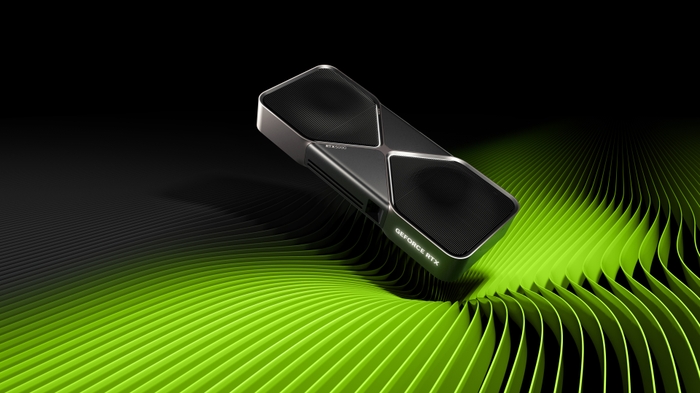
NVIDIA · GeForce RTX 50 Series
NVIDIA GeForce RTX 5090
NVIDIA GeForce RTX 5090 specs, benchmarks, and best prices. 32GB GDDR7, 21760 CUDA cores, Blackwell architecture. The fastest consumer GPU ever made.
Performance
100
SGaming
100
SValue
25
DTypical street price
$2,800–3,600
Launch MSRP $1,999 · Released Jan 2025
Prices vary with the 2026 memory shortage. As an Amazon Associate we earn from qualifying purchases.
Full Specifications
| VRAM | 32GB |
| Memory Type | GDDR7 |
| Boost Clock | 2407MHz |
| Base Clock | 2017MHz |
| Shader/Stream Processors | 21760 |
| Performance | 104.8TFLOPS |
| TDP | 575W |
| Memory Bus | 512-bit |
| Bandwidth | 1792GB/s |
| Architecture | Blackwell |
| Process Node | 4nm |
| RT Cores | 170 |
| AI Upscaling | DLSS 4 |
| Interface | PCIe 5.0 x16 |
| Power Connector | 1x 16-pin |
| Card Length | 304mm |
| Release Date | 2025-01-30 |
Local AI on the RTX 5090
With 32GB of VRAM, here's what this card can run and how fast — estimated from memory bandwidth, the number that actually decides LLM speed.
| Model | Best quant that fits | Est. speed | Verdict |
|---|---|---|---|
| Qwen3.5 35B-A3B | Q5_K_M | ~252 tok/s (Instant-feeling) | Runs great |
| Qwen3 32B | Q5_K_M | ~38 tok/s (Fast) | Runs great |
| DeepSeek R1 Distill Qwen 32B | Q5_K_M | ~38 tok/s (Fast) | Runs great |
| Gemma 4 31B | Q5_K_M | ~41 tok/s (Fast) | Runs great |
| Qwen3 30B-A3B | Q5_K_M | ~229 tok/s (Instant-feeling) | Runs great |
| Qwen3-Coder 30B-A3B | Q5_K_M | ~229 tok/s (Instant-feeling) | Runs great |
| Qwen3.6 27B | Q8_0 | ~31 tok/s (Fast) | Runs great |
| Gemma 4 26B-A4B | Q8_0 | ~126 tok/s (Instant-feeling) | Runs great |
8 of 8 featured models run fully in VRAM on this card. Check a custom model size →
Compare RTX 5090 With
Understand the Specs
Browse all terms →VRAM (Video RAM)
Dedicated memory on a graphics card used to store textures, frame buffers, and render data. More VRAM allows higher resolutions and more detailed textures.
TDP (Thermal Design Power)
The maximum amount of heat a CPU or GPU generates under load, measured in watts. Determines cooling requirements and power supply sizing.
GPU (Graphics Processing Unit)
A specialized processor designed for parallel computation, primarily used for rendering graphics but increasingly important for AI and compute workloads.
Ray Tracing
A rendering technique that simulates how light physically behaves — bouncing, reflecting, and refracting — to produce photorealistic lighting, shadows, and reflections in games.
DLSS (Deep Learning Super Sampling)
NVIDIA's AI-powered upscaling technology that renders games at lower resolution and uses neural networks to reconstruct near-native image quality at much higher frame rates.
PCIe (PCI Express)
The high-speed interface connecting GPUs, SSDs, and expansion cards to your CPU and motherboard. Each generation doubles bandwidth per lane.